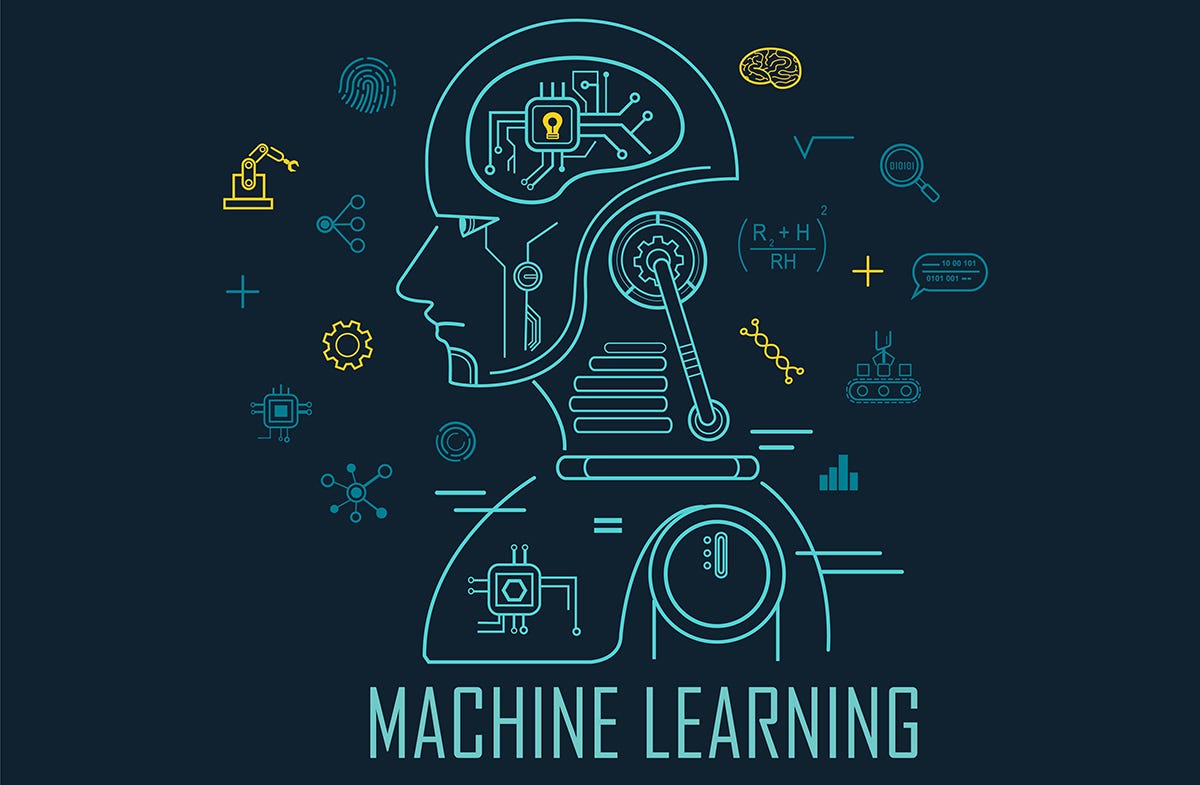
Machine Learning (ML) is no longer just a buzzword—it’s a part of our everyday lives. From the voice assistants in our pockets to advanced robots performing human-like tasks, ML is transforming industries worldwide. In healthcare, it’s helping doctors diagnose diseases faster. In the automobile sector, it’s powering self-driving cars. In retail, it’s delivering personalized recommendations and automating inventory systems. And that’s just scratching the surface.
The global machine learning market, valued at $14.91 billion in 2021, is projected to skyrocket to $302.62 billion by 2030—growing at an impressive 38.1% CAGR. This explosive growth makes ML one of the most in-demand skills to learn by 2025.
Whether you’re starting from scratch or aiming to advance your career in ML, this roadmap will guide you step-by-step through the skills, tools, and concepts you need to master in 2025.

What is Machine Learning?
Think about how you learn any skill—you gather knowledge from different sources, practice repeatedly, and gain experience. This process shapes human intelligence. Machine Learning (ML) works in a similar way: we feed data to a computer, and it learns from that data to improve its performance over time.
Unlike traditional programming, where every step is explicitly coded, ML enables computers to make decisions by recognizing patterns in data. For example, instead of writing rules to identify a cat, we show the system thousands of cat images. Over time, it learns the key features of a cat and applies this knowledge to recognize new images. The more data it processes, the better it gets—just like humans improve with practice.
Now, let’s dive into how you can begin your Machine Learning journey in 2025.
Step-by-Step Roadmap to Master Machine Learning
Step 1: Prerequisites
First, you need to learn some concepts of mathematics and programming before moving on to machine learning.
Learn Mathematics
Linear Algebra
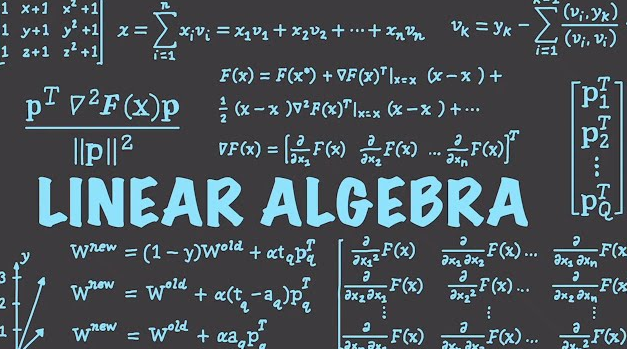
Linear Algebra is the backbone of many Machine Learning algorithms. It deals with vectors, matrices, and the operations that can be performed on them. These concepts are essential for understanding how data is represented, transformed, and processed in ML models.
- Scalars, Vectors, and Matrices – understanding data representation.
- Matrix Operations – addition, subtraction, multiplication, transposition, and inversion.
- Dot Product & Cross Product – essential for understanding geometric interpretations in ML.
- Matrix Factorization – LU decomposition, QR decomposition.
- Eigenvalues & Eigenvectors – vital for dimensionality reduction (e.g., PCA).
- Singular Value Decomposition (SVD) – used in recommender systems, noise reduction, and image compression.
- Orthogonality & Orthonormality – key in optimization and numerical stability.
- Vector Spaces & Subspaces – understanding the structure of data transformations.
- Projections – important for algorithms like least squares regression.
- Norms & Distance Metrics – for measuring similarity or error in data.
Calculus
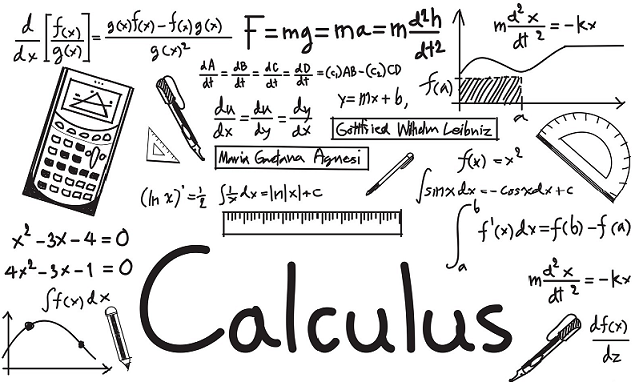
Calculus is essential in machine learning because it helps us understand how models learn by optimizing their parameters. In ML, calculus powers algorithms that minimize errors and improve accuracy through optimization.
- Limits & Continuity – foundational concepts for understanding derivatives.
- Derivatives & Partial Derivatives – measuring the rate of change of functions.
- Chain Rule – essential for backpropagation in neural networks.
- Gradients & Gradient Vectors – direction of steepest ascent/descent in optimization.
- Gradient Descent – the core optimization algorithm in ML.
- Hessian Matrix – for second-order optimization methods.
- Jacobian Matrix – used in transformations and deep learning layers.
- Optimization Techniques – SGD, Mini-batch Gradient Descent, Adam, RMSprop, Momentum.
- Maxima & Minima – finding optimal model parameters.
- Learning Rate Schedules – controlling convergence speed and stability.
- Taylor Series – approximating functions for faster computation in ML models.
Probability & Statistics for Machine Learning

- Basics of Probability
- Sample space, events, and probability axioms
- Conditional probability and independence
- Law of Total Probability
- Bayes’ theorem and its role in ML
- Probability Distributions
- Discrete distributions: Bernoulli, Binomial, Poisson
- Continuous distributions: Uniform, Normal, Exponential, Gamma
- Joint, marginal, and conditional distributions
- Multivariate Gaussian distribution
- Central Limit Theorem and its importance in ML
- Descriptive Statistics
- Mean, median, mode
- Variance, standard deviation, range
- Skewness and kurtosis
- Correlation vs. causation
- Inferential Statistics
- Sampling methods and biases
- Confidence intervals
- Hypothesis testing (null and alternative hypotheses)
- Z-test, T-test, Chi-square test, ANOVA
- P-values and statistical significance .
- Statistical Modeling in Machine Learning
- Maximum likelihood estimation (MLE)
- Maximum a posteriori estimation (MAP)
- Expectation-Maximization algorithm
- Likelihood ratios
- Overfitting, underfitting, and bias-variance tradeoff
- Probability in ML Algorithms
- Naïve Bayes classifier
- Logistic regression and probability interpretation
- Probabilistic graphical models (Bayesian networks, Markov random fields)
- Hidden Markov models (HMM)
- Gaussian mixture models (GMM)
- Uncertainty & Decision Making
- Entropy and information gain
- Cross-entropy loss in classification
- Bayesian inference in ML
- Monte Carlo methods
Learn Programming
- Python (Recommended): Python is the most popular programming language for machine learning. These resources can help you learn Python:
- Youtube
- Github
Understand Key Concepts of Machine Learning
Once you have a solid foundation in mathematics and programming, you’re ready to step into the world of Machine Learning (ML). At its core, ML is about teaching computers to learn from data and make predictions or decisions without being explicitly programmed.
Machine Learning can be broadly divided into three main types:
1. Supervised Learning
Supervised learning uses labeled datasets to train algorithms, enabling them to identify patterns and make accurate predictions.
Key algorithms to explore:
- Linear Regression
- Logistic Regression
- Support Vector Machines (SVM)
- k-Nearest Neighbors (KNN)
- Decision Trees
2. Unsupervised Learning
Unsupervised learning works with unlabeled data, uncovering hidden patterns, relationships, or groupings without predefined outputs.
Key algorithms to explore:
- Principal Component Analysis (PCA)
- k-Means Clustering
- Hierarchical Clustering
- DBSCAN
3. Reinforcement Learning
In reinforcement learning, an agent learns to make decisions by interacting with an environment, receiving rewards or penalties for its actions. While it’s an exciting field, beginners can skip diving deep into it initially and focus on supervised and unsupervised learning first.
Understand Key Concepts of Deep Learning
Once you’ve mastered the core concepts of Machine Learning, the next step is to dive into Deep Learning.
What is Deep Learning?
Deep Learning is a specialized branch of Machine Learning that uses multi-layered artificial neural networks to solve complex problems. By mimicking the way the human brain processes information, deep learning models can handle tasks such as image recognition, natural language processing, and speech recognition with remarkable accuracy.
With its ability to automatically extract features from raw data, deep learning has become the driving force behind modern AI breakthroughs.
Focus on the framework that interests you most, PyTorch or TensorFlow. Start by learning one and you can explore the other one later if needed for a project. Some of the resources are:
Pytorch Github
Tensorflow Github
This guide provides a clear roadmap to learning and mastering ML by 2025. If you’re eager to learn, just remember: the most important step is to begin. Take it one step at a time, and you’ll make steady progress. If you have any questions or need extra help along the way, feel free to leave a comment — I’m here to assist you on your journey!
Great resource for uncovering top AI tools! AI Tools simplifies the search for innovative solutions that can boost productivity and streamline workflows.
Thats cool . Thank you
Great resource for uncovering top AI tools! AI Tools simplifies the search for innovative solutions that can boost productivity and streamline workflows.
Loved the breakdown-tyy.AI Tools is a great resource for finding AI solutions. Their AI Plagiarism Checker is especially handy for content creators. Solid insights here!
Loving the scratch card breakdown! It’s fun to see how tech like AI Chat could add a new layer of excitement to game design. Simple, smart, and playful!
Looking for a reliable Sv388 link? Sv388link seems legit. Got me where I needed to go without any hassle. If you need it, here it is: sv388link
Neo88net is my go-to for some quick gaming action. Easy to get started and they have a good range of options. Give it a shot! neo88net